
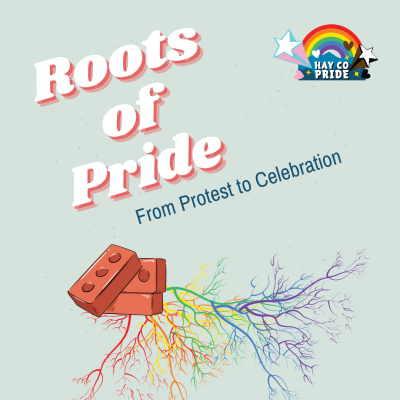
From Protest to Celebration
Happy Pride Month! At HayCo Pride, we know that Pride is 365 days a year, but we relish in Pride Month as a special time of celebration, solidarity, and visibility for the LGBTQIA2S+ community.
The origins of this annual event are deeply rooted in a history of struggle, activism, and defiance against societal oppression. Pride Month emerged from the courageous actions of Queer, Trans and gender nonconforming folks who dared to demand their rights and dignity in the face of discrimination and violence.
The history of Pride Month traces back to the early hours of June 28, 1969, at the Stonewall Inn, a popular and historic gay bar in New York City’s Greenwich Village. At that time, LGBT+ individuals faced routine harassment and persecution by law enforcement agencies. The police launched a raid on Stonewall, not as an isolated incident, but as a culmination of years of oppression and mistreatment.
On that fateful June night, rather than submitting quietly to yet another instance of brutality, the patrons of the Stonewall Inn fought back. Transgender women of color, drag queens, butch lesbians, and gay men joined forces in an act of resistance against police harassment. Their defiance sparked a series of riots and protests that lasted for several days, igniting the modern LGBTQ+ rights movement in the United States.
It’s crucial to acknowledge that the catalysts of the Stonewall Uprising were predominantly trans and gender nonconforming people of color, such as Marsha P. Johnson, Sylvia Rivera, and Miss Major Griffin-Gracy. These individuals, often marginalized even within the LGBTQ+ community, played a central role in the fight for equality. Their contributions laid the groundwork for the emergence of Pride as a political statement and a symbol of resilience.
To commemorate the legendary resistance that took place at Stonewall, a march was organized on the first anniversary of the uprising in 1970. The march was referred to as “Christopher Street Liberation Day,” leading from Christopher Street to Central Park, and it intentionally adopted the theme of “Gay Pride” as a counternarrative that offered liberation in place of shame. In the years following Stonewall, additional marches, demonstrations, and rallies were organized to demand civil rights and societal acceptance. The last Sunday in June was chosen to commemorate the Stonewall Uprising, and thus, the tradition of Pride Month was born.
Throughout the 1970s, Pride events spread across the United States and eventually around the world, becoming an annual tradition for LGBTQ+ communities to come together in solidarity. Over time, Pride Month evolved beyond its roots as a protest against discrimination and injustice. It became a time to celebrate LGBTQ+ identities, cultures, and achievements. Pride parades, festivals, and other events emerged as joyful expressions of love, acceptance, and diversity.
However, amidst the rainbow flags and festive atmosphere, it’s crucial not to forget the radical origins of Pride and the ongoing struggles faced by LGBTQIA2S+ individuals, particularly those who live at the intersection of marginalized experiences as Black, Indigenous, Latine, disabled, poor, and so on.
Today, Pride Month serves as a reminder of the progress made in the fight for LGBTQ+ rights and the work that still remains. While significant strides have been made in legal recognition, social acceptance, and representation, discrimination and violence against LGBTQ+ individuals persist worldwide. Transgender and gender nonconforming people, especially those of color, continue to face disproportionate rates of harassment, homelessness, and homicide.
In this context, Pride Month remains as relevant and vital as ever. It is a time to honor the legacy of those who paved the way for LGBTQ+ rights, to uplift the voices of those still fighting for equality, and to recommit ourselves to the ongoing struggle for justice and liberation.
As we celebrate this Pride Month, let us remember its radical origins and continue the journey toward a more inclusive and equitable society for all, in Haywood County and beyond.
You can join us in nurturing a Haywood County where we can all live with Pride as our authentic selves, free of shame and violence, by signing up to get involved with our Queer Culture Celebration taking place on October 5th, 2024.